Digital marketing debates in 2026 can feel weirdly familiar. Sooner or later, the same question pops up – “Should we spend money on SEO or Google Ads?”
While it is an expected question, it is the wrong question to ask.
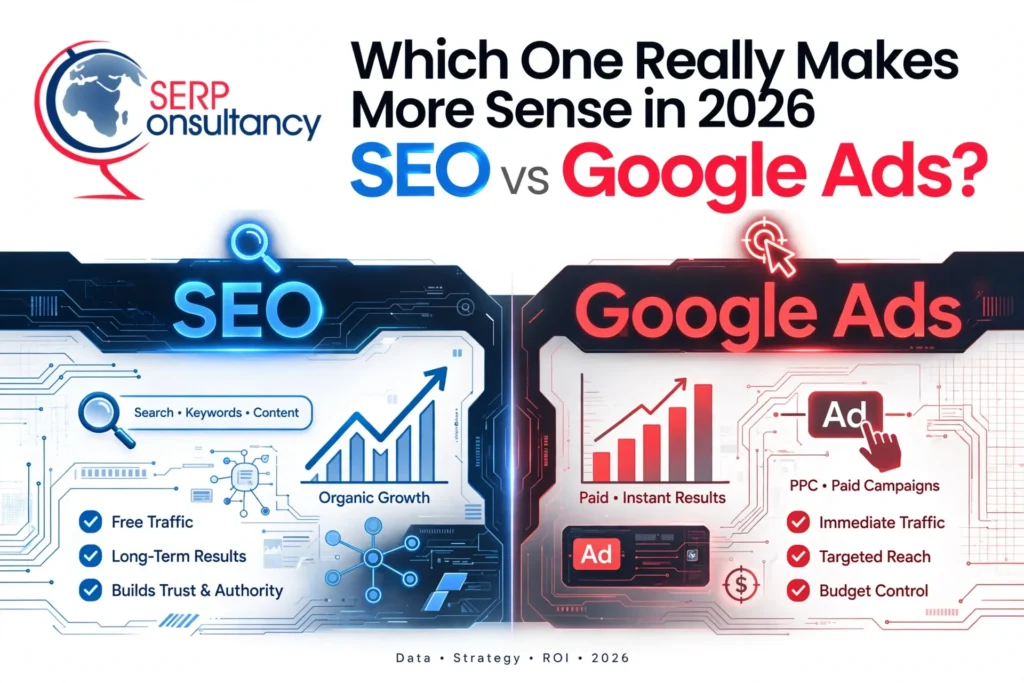
This is because search visibility now is no longer just a straightforward fight between paid clicks and organic traffic. AI-driven search engines have changed the way people find companies. Platforms now summarise content, recommend businesses directly, and lean toward sources that appear reliable, detailed and actually useful.
So businesses are not only competing for clicks anymore. They are competing for placement inside AI-generated responses.
What SEO Looks Like in 2026
SEO in 2026 is much less obsessed with cramming keywords into strange-looking headings.
Modern SEO now revolves around topical authority, search intent, content quality, and contextual relevance. Search engines want to figure out whether your website truly understands a topic deeply or if it just uploaded a few articles after skimming some beginner marketing tutorial online.
AI-powered search systems now look at:
- Topical depth
- Internal linking structure
- Real examples and statistics
- Expert-driven educational content
- Clear answers to specific questions
- Content freshness
- User engagement signals
In other words, this shift means search engines now prefer websites that feel genuinely useful rather than artificially assembled.
That is why companies are investing in stronger SEO campaigns are now producing:
- Detailed guides
- Comparison pages
- FAQ-focused content
- Case studies
- Industry explainers
- Content cluster around niche topics
The objective is not just rankings anymore. The real aim is to become a source that AI systems feel confident referencing. When someone asks ChatGPT about “best HVAC marketing strategies” or asks Claude AI “how local SEO works for dentists,” these systems usually lean toward websites showing steady authority across connected topics. Thin content barely survives anymore.
What Google Ads Still Does Better
Now, even with all the AI-search buzz floating around, Google Ads is definitely not vanishing. Actually, for certain businesses, paid advertising still makes immediate sense.
Google Ads works extremely well when you need:
- Fast traffic
- Immediate lead generation
- Short-term campaigns
- Product launches
- Seasonal promotions
- Hyper-targeted local visibility
SEO is sort of like building a reputation slowly. Google Ads feels more like renting a giant billboard beside a busy motorway during rush hour. You appear instantly, though the visibility disappears the second the budget dries up.
That’s the trade-off, really.
For instance, if a plumbing company in Kolkata suddenly needs emergency leads this week, waiting six months for organic rankings probably is not the smartest route. Google Ads can put them directly before high-intent searchers almost instantly.
The downside?
Clicks keep getting more expensive in competitive industries. Users are getting surprisingly good at tuning ads out. A lot of searchers now scroll straight toward organic suggestions, Reddit threads, YouTube explainers, AI summaries, or trusted editorial pages before making a decision.
People have developed a strange sixth sense for detecting “someone is trying to sell me something.”
SEO Builds Momentum While Ads Drain Budget
This is where the long-term gap becomes pretty obvious. Google Ads behaves a little like switching on a tap. Traffic keeps flowing while money keeps flowing. SEO behaves more like constructing infrastructure – slow in the beginning, but stronger as time passes.
A properly optimised website with topical authority can continue bringing in leads for years from one strong-performing article. Some businesses still get daily visitors from blog posts published three or even four years back.
Ads almost never create that sort of compounding return.
This is also why many startups in 2026 are moving toward educational content strategies instead of depending entirely on paid campaigns. Customer acquisition costs have climbed hard, especially when it comes to the legal, SaaS, healthcare, finance, and home-services industries.
Organic visibility has become one of the few scalable traffic channels that does not endlessly rise in cost.
AI Search Is Quietly Leaning Toward SEO
This is one of the areas that many businesses still underestimate.
AI-powered search experiences are heavily influenced by organic web content. When Google AI Overviews generate summaries or AI assistants provide recommendations, they often pull information from authoritative websites, structured articles, trusted publishers, and well-organised content ecosystems.
Paid ads may still appear within AI-driven search experiences, but informational trust is largely earned through organic visibility and content quality.
Businesses investing in the following are far more likely to appear in AI-generated responses:
- Strong topic clusters
- Helpful educational resources
- Semantic SEO
- FAQ sections
- Expert commentary
- Clear website architecture
This shift matters because user search behaviour is changing rapidly.
Many people no longer search with robotic phrases like “best SEO agency Kolkata.” Instead, they ask conversational and intent-driven questions such as:
- “Which marketing strategy works better for startups in 2026?”
- “Is SEO worth it compared to Google Ads?”
- “How long does SEO take to generate leads?”
Conclusion
AI systems tend to favour content that answers these natural-language questions clearly, directly, and with useful context. In many ways, search behaviour itself is becoming more human week by week.
Must Read:
- Can AI-Generated Content Hurt SEO and Brand Credibility?
- The Rise of AI Content Farms and the Fall of Quality Writing
- Does AI Content Harm Google Rankings? What SEO Experts Say